
Titan was the top loser in the Sensex pack, shedding over 3 per cent, followed by M&M, HUL, Maruti, Asian Paints and IndusInd Bank. Nifty fell 91 points to 17,157.40.

For the banking system a new cycle starts in FY2024. It's fraught with fresh challenges on asset quality and profitability, warns Tamal Bandyopadhyay.

Weakness in Infosys, L&T and Hindalco cap index gains.

The 30-share Sensex ended in the red.

Thus far in FY21, BSE, NSE have rallied 70 per cent and 71 per cent, respectively.

Benchmark Sensex trimmed early gains to close marginally higher while Nifty settled flat in choppy trade on Tuesday as gains in auto shares were offset by selling pressure in banking and energy shares. The 30-share BSE barometer closed marginally up by 37.08 points or 0.06 per cent to 60,978.75 with 15 of its stocks ending in green and the rest in red. The index opened higher and gained over 300 points to a high of 61,266.06 in early trade.

There is merit in considering whether merchandise exports can be facilitated by halting if not reversing the rupee's appreciation, says T N Ninan.

Six entities including four foreign portfolio investors (FPIs) are under lens for suspicious trading in Adani group shares prior to the release of the damning Hindenburg report, the Supreme Court-appointed expert committee has said. There was a build up of short positions in the Adani scips prior to the January 24 release of the Hindenburg report, and substantial profits were booked thereafter as stocks crashed, the 178-page report said. A "short" position is generally the sale of a stock one does not own.
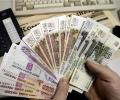
The rouble has been falling steadily since early November and collapsed earlier this month following a spectacular decline in the price of crude oil to five-year lows.

Paring its early gains, benchmark BSE Sensex fell by 304 points on Wednesday as investors booked profit after recent gains amid concerns over inflation and supply constraints. Despite a firm start, the 30-share BSE barometer declined by 304.48 points or 0.53 per cent to settle at 57,684.82. During the day, it tanked 420.71 points or 0.72 per cent to 57,568.59.

'We are not entirely out of the woods.' 'The broader trajectory remains tentative.' 'However, we may expect some near-term bounce.'

'... as has been happening in the last three weeks, then the foreign exchange reserves will not be comfortable to ensure that the rupee does not fall drastically.'

Viom Networks is planning to raise arouns Rs 1500 crore (Rs 15 billion) and is likely to list its shares on the London Stock Exchange (LSE), say sources.

Historically, March has been a volatile month for Indian equity markets. To begin with, it marks the end of a financial year, wherein there is some compulsive portfolio rebalancing trade by large funds - domestic and foreign. Retail investors, too, prefer to 'cash in' on their gains and losses before the financial year runs out.

The risk-reward ratio could turn adverse for foreign investors if corporate earnings disappoint by wide margins, or if crude oil prices spike in the international market, putting pressure on the rupee-dollar exchange rate.
'After multiple days of losses, any relief rally is welcome. However, the trend hasn't changed.'

Equity benchmark Sensex rallied 487 points on Monday to close at a fresh lifetime peak, tracking gains in Infosys, HDFC twins and HCL Tech amid massive foreign fund inflows.
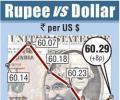
Foreign funds sold Indian shares worth 446.9 million rupees ($7.4 million) on Wednesday, provisional exchange data showed, marking the third consecutive session of outflows.

Reduction in fuel price was supposed to bring back good luck for Indian airlines. But with the global spread of coronavirus, airlines are being forced to rejig their network, cut flights, and delay launches.

On the Sensex chart, Titan, Maruti, SBI, L&T, HDFC and Kotak Bank emerged as prominent gainers. NSE Nifty climbed 190.60 points to settle at 18,003.30.

The Reserve Bank of India (RBI) booked massive gains on its foreign currency sales and needed to provide much lesser for its reserves in 2020-21 (FY21), helping it to carve out a significant Rs 99,122-crore dividend for the government, revealed the RBI's annual report for FY21. By doing so, the central bank's risk buffers have reduced to the bare minimum, which may restrict some of RBI's scale of operations, and would likely hamper dividend payout for financial year 2021-22, said analysts. The annual accounts are for nine months ended March 31, 2021 since the RBI changed its accounting year from July-June to April-March from FY21.
It was primarily due to a higher trade deficit ($41.6 billion) brought about by a larger increase in merchandise import.

Billionaire Mukesh Ambani's children -- Isha, Akash and Anant -- on Monday were appointed on the board of his energy-to-technology conglomerate Reliance Industries Ltd, in what is seen as a clear path of succession planning at India's most valuable company.

Benchmark BSE Sensex rallied nearly 630 points while Nifty closed above the 16,500 mark on Wednesday after sharp gains in IT and energy shares amid positive global market trends. Buying in index majors Reliance Industries, Infosys and Tata Consultancy Services and FII inflows bolstered the sentiment. Shares of firms related to oil exploration and refineries were in heavy demand, with Reliance Industries rallying 2.47 per cent and ONGC by 4 per cent, as the government slashed windfall tax on petrol, diesel, jet fuel and crude oil.

On October 18, the tax department had said searches had led to detection of undisclosed income of more than Rs 500 crore in addition to Rs 93 crore worth seizures, including gold jewellery and diamonds. A revised appraisal of such seizures now pegs its value at Rs 106 crore which includes cash (Rs 45 crore), gold jewellery and diamonds (Rs 41 crore) and foreign currency Rs 20 crore.

Rejecting the allegation of illegally receiving foreign funds, Aam Aadmi Party has told the Delhi high court that it got donations worth Rs 30 crore from Indian citizens only, out which about Rs 8.5 crore came from NRIs.

Tata Motors was the worst performer on the Sensex, plummeting 10.32 per cent to Rs 436.55 after the company reported a steep 96.22 per cent decline in consolidated net profit for the December quarter.

Indian companies are in a precarious financial position.

Under the trade agreement between India and Iran, the West Asian country can pay India in rupees for its imports against oil exports to India, which New Delhi pays for in Iranian rial.
The rupee closes 12 paise down against the dollar.

Goldman Sachs downgraded its rating on Indian stocks to 'underweight'.

The 'BluFin Business Cycle Indicator', which reflects various macroeconomic trends on a monthly basis, stood at 166.3 points in May, 5.8 per cent higher compared to the same month last year, suggesting that the Indian economy is growing at a faster rate than the previous year.

'By annoying the Arabs and cozying up to Iran, Pakistan may end up losing Arab economic support, annoying the Americans and increase Shia-Sunni tensions domestically,' Colonel Anil A Athale (retd) points out.

The branch managers have come out of their glass cabins and the sellers' market has transformed into a buyers' market, but there is no end to the harassment of customers, asserts Tamal Bandyopadhyay.

Overall forex market sentiment suffered a sudden reversal of fortune contrary to expectation largely moving in line with local equities, reversing all early strong gains.

Bhargavi Zaveri & Radhika Pandey explains how complexities of foreign exchange rules are used by India Inc to dispute contractual obligations.
RBI Governor Shaktikanta Das has assured Finance Minister Nirmala Sitharaman that the Rs 12.05-trillion gross borrowing programme for FY22 will go through smoothly.
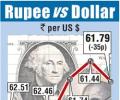
Traders say the rupee and other global currencies will likely track the continued uncertainty in the US budget stalemate and government shutdown.
After staging a strong recovery from COVID-induced slowdown in 2021, India's exports are likely to extend the growth story to the New Year also on increased demand in the global markets, boost in domestic manufacturing due to production-linked incentive schemes and implementation of some interim trade pacts. Expectations of positive growth in the country's exports are also backed up by the outlook of the World Trade Organisation (WTO) which predicts a 4.7 per cent expansion in the global merchandise trade volume in 2022. Exporters believe that the outbound shipments would cross $400 billion mark in this fiscal going by the current momentum and may reach $475 billion in 2022-23.
The gains were capped due to month-end dollar demand from importers, mainly oil firms
 © 2026 Rediff.com - Advertise with us - Disclaimer - Privacy Policy - Sitemap - Feedback - About us - Terms of use - Grievances